Think Smarter
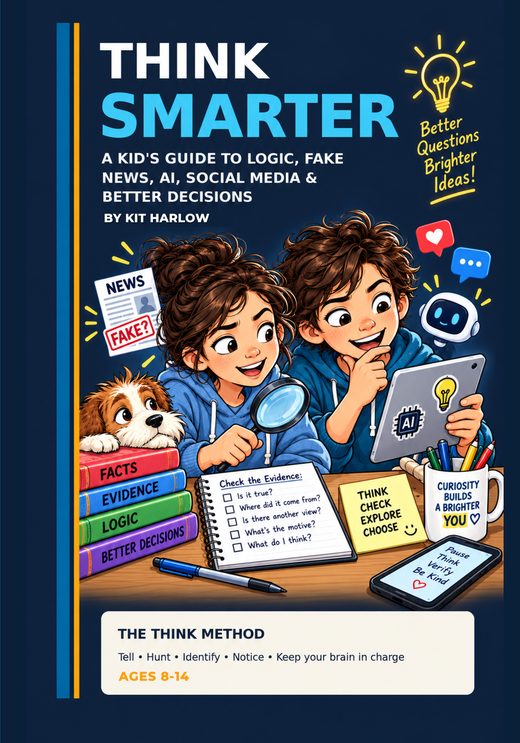
A kid’s guide to logic, fake news, AI, social media and better decisions. Everything else on this site is a document written for you. This is the one you hand to them.
Why a book for the child
Every product on this site works on the parent’s side of the problem: the readiness test, the settings, the agreement, the scripts. All of it is about what you decide and what you set up.
None of it survives contact with the thing that actually happens, which is your child alone with a screen, at 11pm, being told something confidently by a stranger, an algorithm, a friend, or a chatbot. At that moment the only protection in the room is what they can do with their own head.
210 pages · 7×10 paperback · full colour, illustrated · 30 chapters
The habit the whole book is built around
Before you believe, share, buy, argue or act: What is the claim? What evidence supports it? What might be missing? Who benefits if I believe it? What is the smartest next step? Five questions, about five seconds. Everything else in the book is practice at asking them when it is hard.
What’s in it
Thirty short chapters in three parts. Each one ends with a Think-It-Through challenge — a real situation to argue about rather than a comprehension question.
-
1
How to spot bad thinking
Claims versus facts. The bandwagon trap — “everyone is doing it.” Straw men, false choices, slippery slopes, attacking the person, appeals to authority, cherry-picking, correlation and causation, emotional reasoning, confirmation bias, and the sunk-cost trap. Twelve chapters, all in playground language.
-
2
Thinking in the digital world
Why viral does not mean true. Fake screenshots and edited clips. Why AI sounds certain and is sometimes wrong. Deepfakes. How algorithms choose what you see. Influencers and hidden persuasion. Scams that work on your emotions. And privacy as a decision rather than a default.
-
3
Better decisions
The power of the pause. Reversible versus irreversible choices. Thinking in consequences. Possible versus probable. Opportunity cost. Building a decision matrix. Asking what would change your mind. Disagreeing without becoming enemies. Knowing when to ask an adult — and writing their own thinking code.
The chapter that matters most right now
Chapter 15 is called AI Can Sound Certain and Be Wrong, and it is the same point the AI readiness guide makes to you, said to them: these systems generate likely-sounding output, they are built to be agreeable rather than correct, and confidence is not evidence. It asks the reader to go and check an AI answer against two reliable sources and notice what changed.
That is the half of AI safety nobody sells, because it cannot be bought as a setting. You can lock a device down completely and your child still meets this on a friend’s phone, at school, and for the rest of their life.
Where it sits with everything else here
It is deliberately the same argument from the other side of the table, for exactly the same children — this site is written for parents of 8 to 14 year olds, and the book is written for 8 to 14 year olds. Three examples:
- “I’m the only one without a phone.” You get the guide about holding the line. Chapter 2 gives them the bandwagon trap, and the question that goes with it — would this still be a good idea if nobody else were doing it?
- The AI conversation. You get the AI Readiness Test. They get chapters 15 to 17 — AI error, deepfakes, and why the feed keeps showing them the same thing.
- The setup. You get the settings walkthrough in The System. They get chapters 19 and 20 — how scams use urgency, and why an app asking for your contacts is a decision rather than a formality.
Who it isn’t for
It is not a screen-time book and it does not tell children technology is bad. It is not a substitute for the settings on the device, and a nine-year-old reading it does not make an unconfigured phone safe. It also will not work as a punishment: handed over after an incident, it reads as a lecture. Give it to them when nothing has gone wrong.
For parents and teachers
There is a note at the back that is really the point of the whole thing: the way to teach this is not to demand that children agree with adults. Ask them to explain their reasoning. Ask what evidence would change their mind. Say “I was wrong,” “I’m not sure” and “let’s check” out loud where they can hear you. That is what turns critical thinking from a lesson into something that happens in the kitchen.
The book ends with a ten-question checklist and a week-long challenge — one claim, one decision and one thinking tool logged each day — which works as well at a dinner table as it does in a classroom.
Not on Amazon yet
The book is finished and the paperback files are with the printer. It is not listed yet, and there is no pre-order — so rather than park you on a waiting list, here is the thing it pairs with, free and available now.
Get the free AI Readiness TestIt’s the parent’s half of this book: which of the three things called “AI” is on the phone, eight signals, and what to say. One email, unsubscribe whenever you like.
Related
- Is my child ready for AI? — the guide this book is the other half of. Free to read, no email.
- The 12-point phone readiness test — free, if the phone itself is the decision in front of you.
- All the guides — first phones, rules, and the “everyone else has one” argument.