Is your kid ready for AI?
Three completely different things get called “AI” and only one of them is the one the headlines are about. Find out which one is on the phone, then eight signals that matter more than their age and the four situations where the answer is no.
One confirmation click, then it’s in your inbox. No spam, no selling your address, unsubscribe in one click.
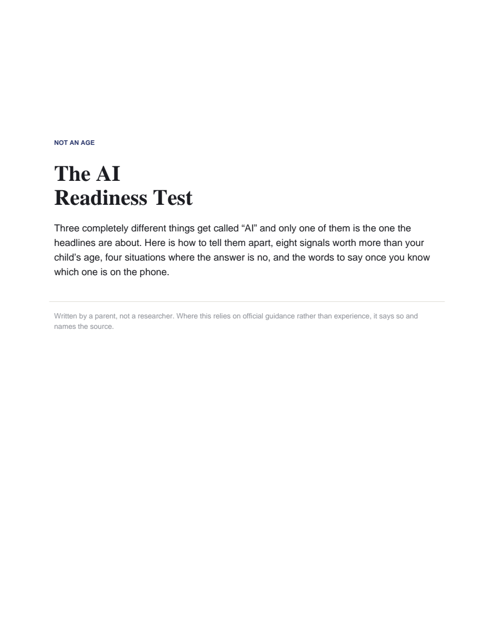
What’s on it
Nine pages, plain language, nothing to install. Print it or read it on your phone — it’s built to be scored in one sitting while your kid is at school.
Start on page two
Almost every argument about kids and AI is two people talking about different products. A parent picturing a chatbot that tells a fourteen-year-old it loves her is not in the same conversation as a teacher picturing an essay written in four seconds. Both are real. They need completely different answers — and scoring your child before you know which one is on the phone gives you a number about nothing. So the test sorts that out first, and it takes one question.
-
3
Kinds of “AI,” told apart
The homework one, the assistant already built into the phone, and the companion app designed to feel like a friend. Different risks, different actions. Only the third is the one the research and the regulators are actually about.
-
8
Readiness signals, scored
Things you can observe this week — whether they’ve ever caught one being wrong, whether they treat agreement as proof, whether a problem still goes to a person first. Score it and you have an answer instead of a feeling.
-
4
Hard stops
If any one of these is true, the answer is not yet — whatever the score said. One of them is about you rather than your child, and it is the only one on the list you can clear tonight.
-
3
Scripts
Word for word: how to open the conversation without it becoming an interrogation, the one sentence that does most of the work, and what to say about a companion app if that is what you find.
What this test cannot do
Parental controls for these products are much thinner than the ones you know from phones. Where they exist you can generally link accounts, set quiet hours, turn off memory and history, and get an alert if the system thinks something is badly wrong. What you usually cannot do is read the conversations — and screen-time apps do not read them either. The test is honest about that, and about what it means: the signal doing most of the work is still whether your child comes and tells you.
Why one more checklist
Because the advice you have read so far either gave you an age rating or told you to ban it, and neither survives contact with a phone that already has an assistant built into the operating system. There was no moment where you decided. This is a way to work out where you actually stand and what to do about it.
Where it gets serious it points you at the people doing the research rather than paraphrasing them — Common Sense Media’s assessment with Stanford Medicine’s Brainstorm Lab, and the FTC’s inquiry into companion chatbots. No invented statistics, and nothing pinned to a number that will be stale in a month.
It’s free because it’s how you find out whether the way I think about this is any use to you. If it is, there’s more. If it isn’t, keep the test anyway.
Send it over
One email, then the test. Unsubscribe whenever you like.
Related
- Is my child ready for AI? — the long version of this, free to read with no email.
- The 12-point phone readiness test — the other half, if the phone itself is the part you haven’t done.
- Think Smarter — the book version of all this, written for the child rather than for you.